Solar Panel Bird Proofing in Chicagoland
Spikes, netting, and deterrents to keep pigeons and birds off your panels and away from your wiring. $8-12 per linear foot of protected edge. Free estimates.
Why Birds Are a Problem for Solar Owners
Pigeons, starlings, and sparrows are drawn to the warm gap beneath solar panels, especially in Chicagoland winters. Once they establish a roosting or nesting spot, corrosive droppings accumulate on panel glass and frames, reducing efficiency and accelerating degradation. A single nesting pair can attract a colony within weeks. Early bird proofing is significantly cheaper than cleaning up after an established colony.
Spikes, Netting, or Mesh: Which One You Need
The right deterrent depends on what the birds are actually doing, not on which product is cheapest. Three different behaviours need three different answers.
Birds perching along the panel edge or ridge, leaving droppings on the glass. This is a landing problem. Spikes or deterrent strips along the panel frame edge and the adjacent roofline stop them settling. Spikes do not harm birds; they simply remove the flat surface. They only go on open landing spots, though: tucked near the gap under the panels, pigeons can use them as a frame to build a nest on.
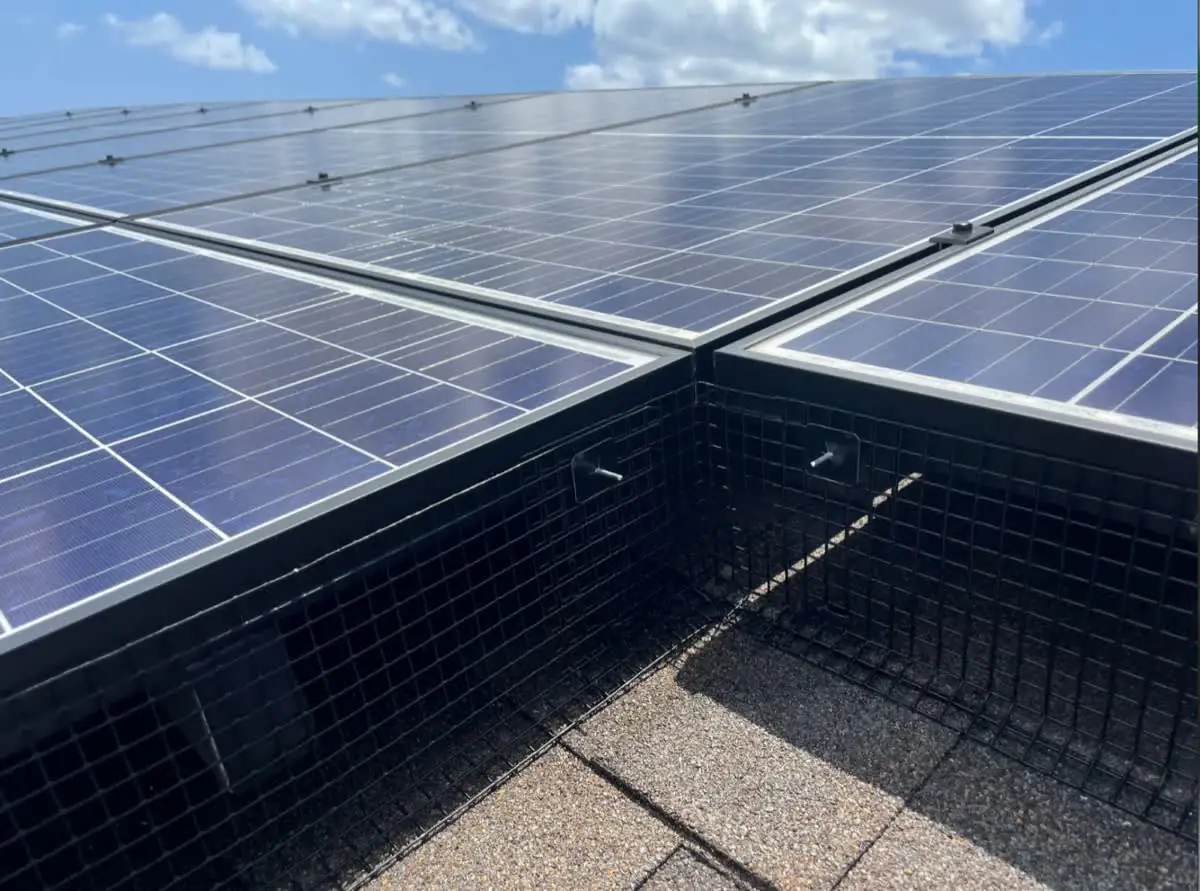
Birds nesting in the gap underneath the array. Spikes will not touch this, the birds are not landing on top, they are walking in from the side. This needs the perimeter sealed with mesh critter guard, which is the same fix as for squirrels and rodents.
Birds roosting on a larger structure near the array, a chimney, a dormer, a run of gutter. Netting is the tool for an open span that spikes cannot practically cover.
Homes near mature trees, or anywhere along the lakefront migration corridor, very often have both problems at once. If you can see droppings on the glass and hear activity under the panels, you need both, and we discount them installed on the same visit. Our full comparison guide walks through how to tell which you are looking at.
How the Install Works
- We look before we quote. Perimeter length, roof pitch, deterrent type, and whether anything is currently nesting all change the number. Bird proofing is priced at $8-12 per linear foot of protected edge, and you get the total before any work starts.
- Clear and clean first, never seal over an active nest. Any nesting material comes out and the panels and roof surface get cleaned before anything is fixed in place. Sealing a nest in is how you turn a bird problem into a smell problem. Pigeons are homing birds and leftover droppings smell like home, so the cleanup matters as much as the hardware.
- Fix to the frame and the roofline, never to the panels themselves. Deterrents attach at the panel frame edge or the adjacent roof surface. Nothing is screwed, drilled, or glued to panel glass or the backsheet, that is what voids a warranty.
- Check the whole perimeter, not just the visible side. Birds use the side you cannot see from the driveway.
- Visual inspection while we are up there, included: chewed wiring, cracked glass, lifted clamps, and any damage the birds already did.
Most residential bird proofing is a single visit. What drives the time is perimeter length, roof pitch and access, and how much cleanup the existing mess needs, an array that has been nested in for three seasons takes considerably longer than a preventative install on a clean roof.
Booking, Payment, and Scheduling
- Quotes are free. We quote from photos and a few questions for most residential jobs, or on site where access needs a look first.
- A 30% deposit confirms a residential booking once you approve the quote. That is what reserves the date. The balance is due after the work is finished, so you see the result before you pay the rest.
- Payment: secure card or bank link, Zelle, Venmo, check, or cash.
- Weather. We do not clean in rain, high wind, or on iced surfaces. If we have to move your date for weather, we reschedule at no charge, rescheduling is on us, not on you.
- Spring books out. Late April through May is the highest-demand window of the year across all six counties. If you want a May slot, book it well ahead, or put the visits on an annual contract and we schedule them for you.
- Satisfaction guarantee. If the result is not right, we come back and re-clean.
Frequently Asked Questions
See the Damage Birds Do, and the Fix
Rated 5.0 by 59+ Pane Pal customers across window, gutter, and solar services.
Request a Quote
Form not loading, or prefer to skip it?
Call or text for the fastest answer, most quotes go out the same day. To quote by email, send your address, roughly how many panels you have, whether the array is roof or ground mounted, and what you need done.