Deionized Water vs. Pressure Washing Solar Panels
Pressure washing solar panels voids most warranties. Why deionized water is the only safe method, and what the wrong one costs.
Short answer: never pressure wash solar panels. Deionized water with a soft brush is the only method that cleans them properly and keeps the manufacturer's warranty intact.
The most common solar panel cleaning mistake is reaching for a pressure washer. It is fast, it is cheap, and it will cost you the warranty on a $20,000 system.
Why Pressure Washing Damages Solar Panels
Solar panels are engineered to survive rain and hail striking the front glass at whatever angle nature supplies. They are not engineered for a concentrated jet held a foot away. What goes wrong:
- Micro-cracks in the cells. Silicon cells are brittle and only a couple of hundred microns thick. Pressure flexes the laminate, and cracks form that are invisible from the roof but show up under electroluminescence imaging. They do not fail the panel immediately; they create resistive spots that slowly erode output and can become hot spots.
- Frame and seal intrusion. Forcing water past the edge seal is how moisture reaches the backsheet and the junction box. That path leads to corroded interconnects, delamination, and in bad cases ground faults.
- Anti-reflective coating erosion. The front glass carries a microscopically thin AR coating that buys you a few percent of light transmission. It is not built to be abraded, and once it is gone it does not come back.
- Warranty exclusion. Panel warranties near-universally exclude damage from improper cleaning. Pressure washing is the textbook example, and the damage signature is recognisable, so "I do not know what happened" is not a workable position in a claim.
Why Deionized Water Works
Deionized water has had dissolved minerals stripped out by ion exchange. Ordinary Chicago-area tap water carries dissolved solids typically measured in the hundreds of parts per million; properly deionized water is close to zero. That single difference is what does the work.
- No mineral deposits. Tap water evaporates and leaves behind every mineral it was carrying, as spots on the glass. Those spots are opaque, and they accumulate with each wash.
- It rinses spot-free, so nothing has to be wiped dry. No wiping means no chance of dragging grit across the AR coating.
- It actively lifts dirt. Water this pure is chemically "hungry" and pulls dissolved contaminants off the surface rather than depositing more.
- No chemicals to leave a film that then attracts the next round of dust.
- Manufacturer compliant across the major panel brands.
The Correct Method
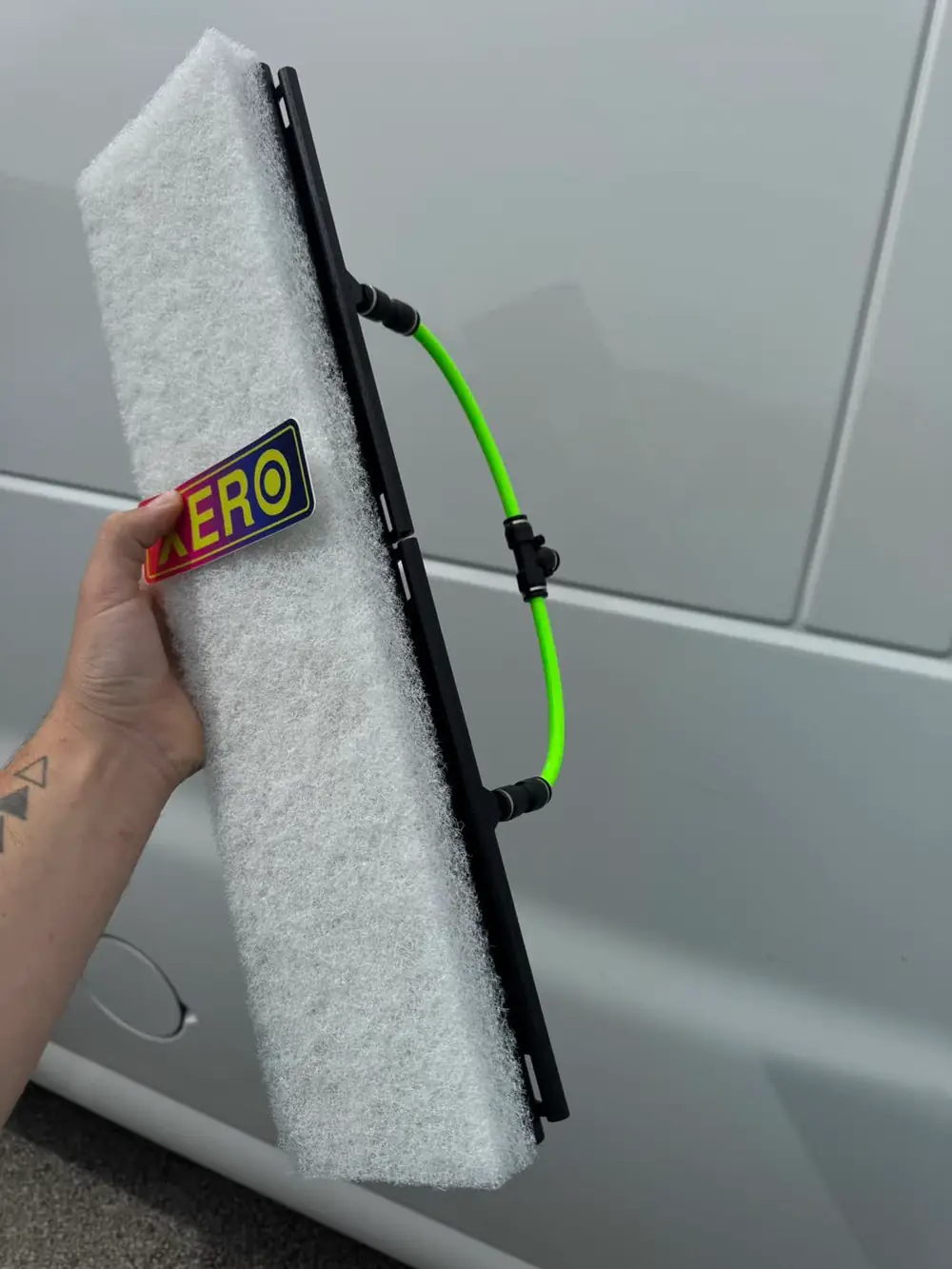
This is the tool that touches your panels: a soft pad head fed by pure deionized water through the pole itself. The process:
- Rinse with DI water to float off loose grit before anything mechanical touches the glass. Skipping this step is how panels get scratched.
- Work the surface with a soft brush or pad, low pressure, following the long axis of the panel. The water does the lifting; the brush only agitates.
- Final DI rinse, sheeting the water off the low edge.
- Air dry. No towels, no squeegee, no wiping.
- Visual inspection while we are up there, cracked glass, lifted clamps, chewed wiring, nesting under the array.
Two practical notes. Panels are cleaned early or late, not at midday in July: DI water hitting hot glass evaporates before it can sheet off, and thermal shock on hot glass is its own risk. And we work from the ground with a water-fed pole wherever the array allows, because staying off a wet roof is safer for everyone and avoids putting weight on the panels.
This is exactly the process we use on every residential solar panel cleaning across Chicagoland, see it applied to a real bird-damaged array in our Glenview before-and-after case study.
The Five Mistakes We Are Called Out to Fix
These are the ones that actually show up on Chicagoland roofs:
- Garden hose and dish soap. The soap leaves a surfactant film that holds the next round of dust, so panels look clean for a fortnight and then soil faster than before. The hose water then spots them as it dries.
- Glass cleaner. Ammonia-based cleaners attack the AR coating and the frame seal. Nothing intended for household windows belongs on a panel.
- A squeegee or a towel. Any grit you failed to rinse off first becomes sandpaper the moment you wipe. Most of the fine scratching we see came from someone being helpful with a microfibre cloth.
- Scrubbing dried droppings dry. They have to be soaked and floated off. Attacking them dry takes the coating with them.
- Hot water or de-icer in winter. Thermal shock cracks glass. Every winter someone tries this on a snow-covered array. See our winter guide for what is actually safe.
Can You Do This Yourself?
Yes, with real caveats. A basic DI setup, a resin canister, a water-fed pole, and a soft brush head, runs roughly $150-$400, and the resin needs replacing periodically depending on how hard your tap water is. If your array is ground-mounted or reachable from the ground with a pole, doing it yourself is sensible and we will happily tell you so.
Where it stops making sense is a pitched roof. Falls from height are the actual risk in this trade, not the cleaning, and a wet panel is roughly as grippy as wet ice. Walking on panels also voids warranties independently of how you clean them. If the array cannot be reached from the ground, the equipment cost is not the deciding factor, access is.